

Cheek
Augmentation
Surgery
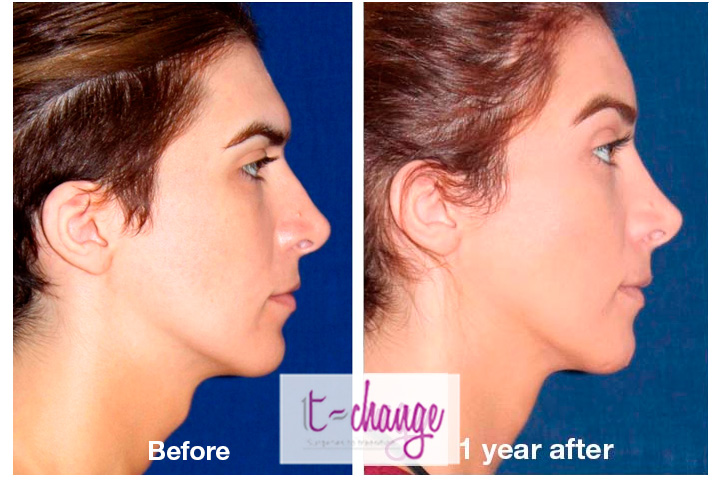
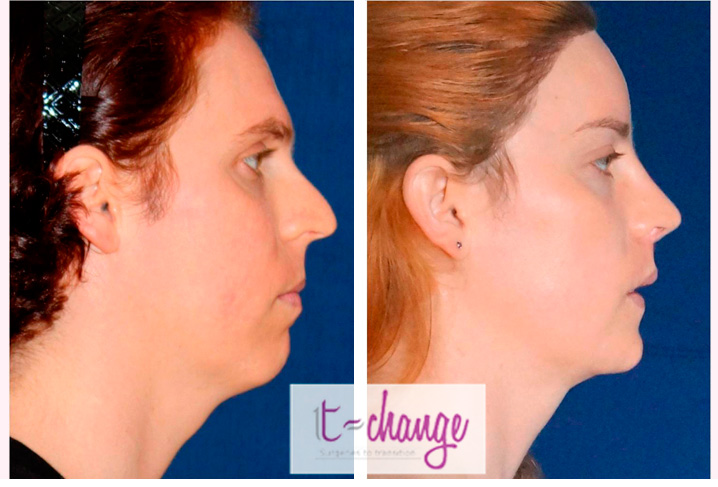
Creating higher, fuller and more defined cheekbones — one of the most recognizable feminine facial traits, achievable through implants or fat grafting.
Cheek augmentation — before & after
All photos published with patient consent. Individual results vary based on anatomy, procedures performed and recovery.
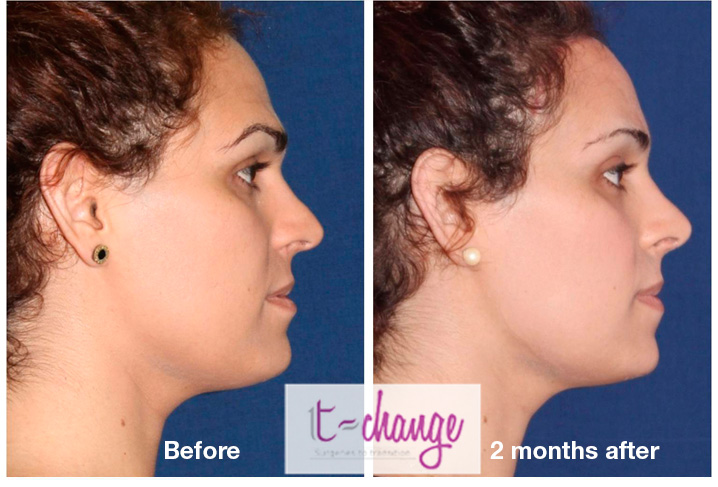
Malar Augmentation
Cheeks + Lipofilling
Prominent, defined cheeks are one of the most universally feminine facial traits
Female cheeks tend to be more prominent and clearly defined than those of men — and they cover a proportionally larger area of the mid-face. High, full cheekbones create the gentle convexity that gives the face its characteristically feminine softness and structure, framing the eyes from below and drawing attention to the center of the face.
Cheek augmentation for facial feminization can be achieved through two different approaches — permanent implants or lipofilling (fat grafting) — each with distinct characteristics. The right choice depends on the patient's anatomy, the degree of volume needed and whether they are local or come from abroad.
Neither of these technique leaves visible external scars.
Procedure at a glance
Implants or lipofilling —
which is right for you?
Both techniques achieve feminine cheekbone volume and definition. Lipofilling allows for a more comprehensive result because it's not only limited to the size and shape of an implant, but allows to fill in other areas around the cheeks, like under-eye circles and marionette lines (nosolabial folds).
Permanent — more invasive
Cheek Implants
Solid silicone implants are placed through a small pocket created behind the cheek muscles. This material is widely used in FFS. Each implant can be sculpted at the time of surgery to precisely match the patient's anatomy. The result is immediate, permanent and highly predictable.
Permanent result — no risk of reabsorption
Customizable at surgery to match your exact anatomy
Suitable for larger volume increases
Higher risk of complications: infection, rejection, shift
Natural — your own tissue
Fat Grafting (Lipofilling)
Fat is harvested from another area of the body — typically the abdomen or thighs — purified and then injected as micro droplets into the cheek area in precise layers. Because it uses the patient's own tissue, the risk of rejection is essentially zero and the result integrates naturally with the surrounding structures. A portion of the transferred fat may be reabsorbed over time, for which an over correction is generally done.
Uses your own tissue — zero risk of rejection
Very natural texture and integration
Partial reabsorption possible — a touch-up may be needed
Two incision options for implants
Implants can be inserted through an incision along the upper gums (fully invisible) or an incision at the inner side of the lower eyelid. The eyelid approach carries a small risk of ectropion — a temporary or permanent eyelid outward turn that may require corrective surgery. The gum approach has a higher risk of infection.
One of the easiest recoveries
in facial feminization
Cheek augmentation with lipofilling has one of the most straightforward recoveries among FFS procedures. Bruising is uncommon, swelling typically resolves within two weeks, and most patients can resume social activities quickly. Cheek implants, on the other hand, can be painful and uncomfortable, and swelling settles down after 6 months. Make-up can be applied the day after surgery.
Sleeping with the head elevated during the first days accelerates recovery.
- Make-up allowed from the day after surgery
- Swelling from lipofilling settles down in 2 to 4 weeks. Swelling from cheek implants take longer to settle down completely: 6 to 12 months.
- Cold compresses during the first days are recommended to reduce swelling from cheek augmentation with implants, but these must be avoided in the case of lipofilling.
- Sleep with head elevated for the first few nights.
- Final result fully visible at 2 months with lipofilling, and 6 to 12 months with implants.
Risks & considerations
Asymmetry
Carefully marked and planned pre-surgery. Minor asymmetries could potentially be corrected after full healing with lipofillig, if patient's fat is available.
Implant displacement
A displaced or shifted implant requires corrective procedure to reposition it. If the displacement is caused by rejection, the implant must be removed.
Ectropion (when implant is inserted through the eyelid only)
The lower eyelid may turn outward if implanted through the eyelid. Can be temporary or permanent — correctable with eyelid surgery. The gum approach avoids this risk but carries a higher risk of infection.
Fat reabsorption (lipofilling)
A percentage of transferred fat may be reabsorbed naturally over the months following surgery. For this reason, an overfilling is routinelly done. A touch-up session may be needed to maintain the desired volume.
Explore other FFS procedures
Ready to take the next step?
We're here to guide you.
Book a free online consultation with our team. We'll review your goals, answer your questions and outline a personalized surgical plan — before you commit to anything.