
Before & After
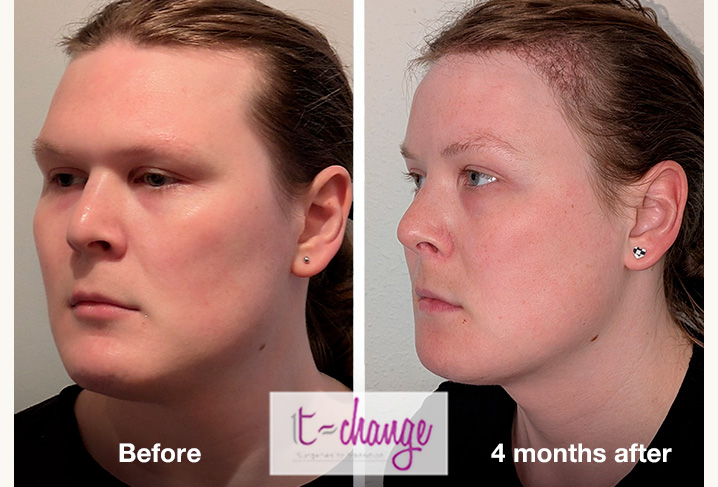

The Adam's apple is the most prominent external sign of the male larynx — the cartilage structure that grew disproportionately during puberty to support a deeper voicebox. Young children don't have it; it is rare in women. For many transgender women, it can be a wrong gender marker even when every other facial feature is fully feminine.
Tracheal shave — also called laryngeal shave, thyroid cartilage reduction or chondrolaryngoplasty — surgically reduces the protruding cartilage through two approaches: a) a small incision placed in a natural crease at the top of the neck, where the resulting scar becomes well conealed. b) Endoscopic scarless tracheal shave through an incision inside the mouth. In both cases the cartilage is shaved, trimmed and smoothed so no irregularity is visible or palpable through the skin.
It is one of the simplest and fastest procedures in FFS — but it must be performed by an experienced surgeon, since excessive reduction can weaken the laryngeal structure and permanently affect vocal quality. At T-Change, this is approached with the same precision as any craniofacial procedure.
Procedure at a glance
All photos published with patient consent. Individual results vary based on anatomy, procedures performed and recovery.
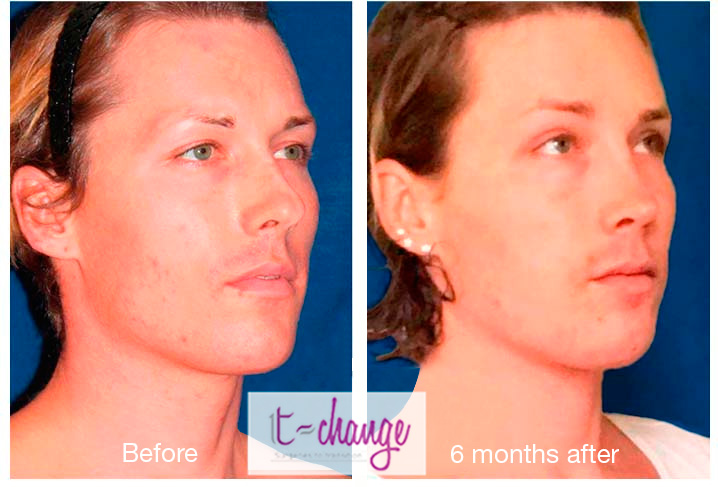
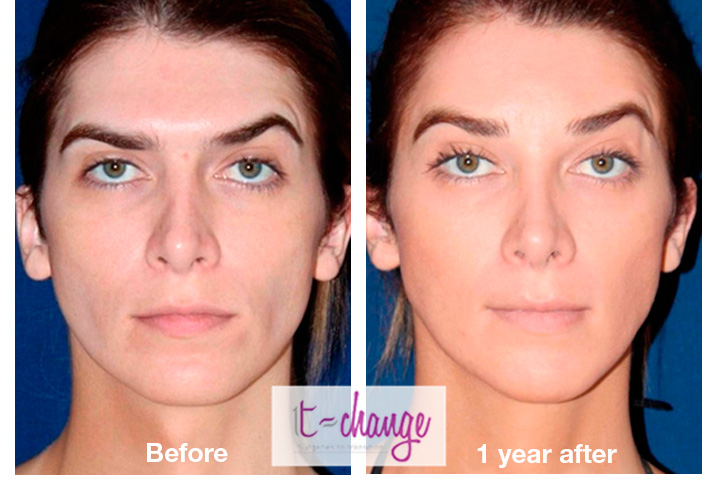
Patients who have undergone tracheal shave consistently report that the post-operative sensation is very similar to a common sore throat — including some reduction in the ability to speak loudly, mainly caused by the anesthesia intubation. This is temporary and typically resolves within 7 to 10 days.
For direct incision approach, a small piece of adhesive tape covers the incision for the first 2 to 3 days. The incision is placed along a natural horizontal crease at the top of the neck, so the scar is concealed by the skin's own fold.
For the endoscopic scarless trachea shave, dissolvable stitches are placed inside the mouth, along the bottom gum.
Days 1–3
Small adhesive tape in place for direct incision approach. Rest recommended. Some difficulty swallowing, mainly from aneshtesia intubation. Mouthwash for hygiene in case of endoscopic approach.
Days 4–10
Sensation of sore throat goes down progressively.
Week 2
Most patients return to social activities. Voice returns to normal volume.
Weeks+
Scar fades into the neck crease. Result is permanent and fully settled.
Risks & considerations
Voice quality change
The most important risk. An excessively aggressive shave can weaken the laryngeal structure and permanently affect vocal pitch or range. Experienced surgical judgment is critical.
High frequency reduction
Some patients — particularly singers — report a temporary reduction in their ability to reach the highest vocal frequencies. Usually resolves fully.
Hypertrophic scar (only with direct incision approach)
Thick and red scar (keloid) due to individual skin characteristics. — discussed during pre-surgical consultation.
Vocal fold damage
Very rare when performed by an experienced ENT or head & neck surgeon. At T-Change, Dr. Rossi's training in head and neck surgery makes this risk minimal, and it has never happened.
Book a free online consultation with our team. We'll review your goals, answer your questions and outline a personalized surgical plan — before you commit to anything.