

Chin
Feminization
Surgery
Reshaping the lower point of the face — reducing width and height, and djusting projection to create the softer while pointed chin that completes a feminine facial silhouette.
The chin is the final point of the facial frame — and it shapes everything above it
A feminine chin tends to be smaller than a masculine one in every dimension — narrower, shorter, and with less projection. While male chins tend to be square, female chins are typically more rounded and pointed.
The chin is one of the most surgically versatile areas of the face. Height, width and projection can all be modified — independently or in combination — depending on what the patient's anatomy requires. Three different techniques exist, and the right choice depends entirely on which dimensions need to be changed.
Chin feminization is almost always performed together with jaw reduction in the same session, since these two structures form a single visual unit. Treating one without the other rarely produces a fully harmonious result.
Procedure at a glance
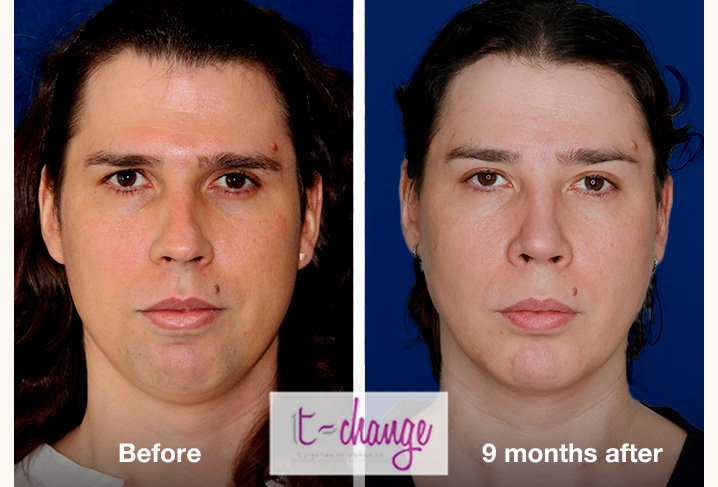
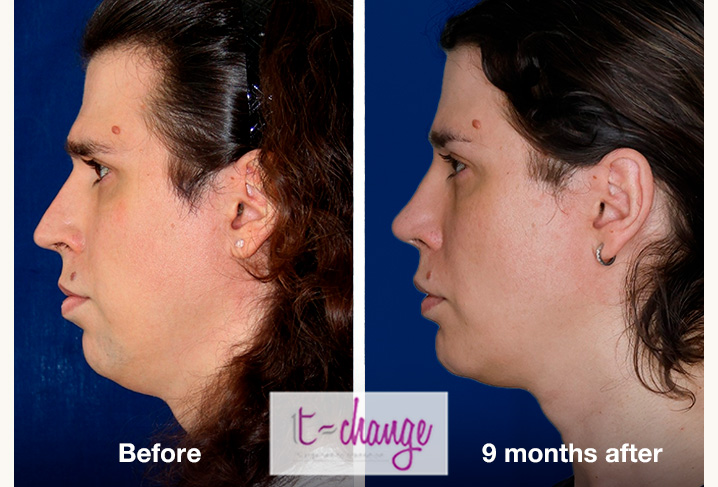
Chin feminization — before & after
All photos published with patient consent. Individual results vary based on anatomy, procedures performed and recovery.
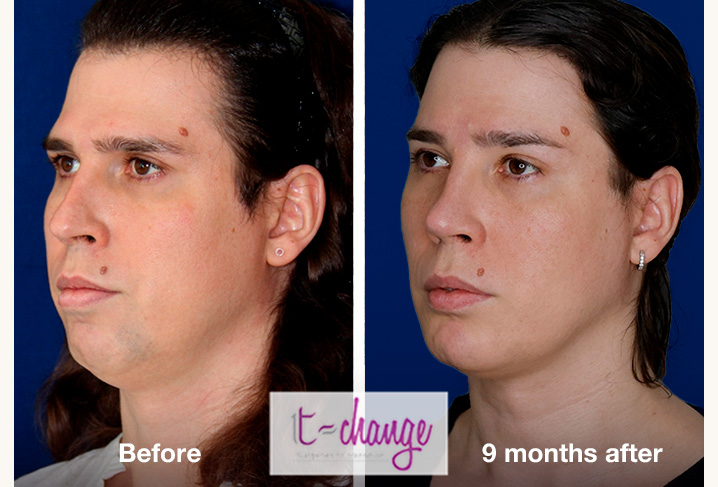
Chin Reduction and advancement (sliding genioplasty)
Actual Patient
Chin Reduction and advancement (sliding genioplasty)
Actual Patient
Three techniques — one chosen
for your exact anatomy
Like it happens with other FFS procedures, chin feminization does not have a single standard technique. The right approach depends on which dimensions need to change — and sometimes all three techniques are combined.
When the only need is increased projection (rare)
Chin Implant (the less commonly used)
Used when the chin needs more projection or a pointier shape — without changing its overall size. Implants are made of solid silicone, widely used and well-tolerated in FFS.
When shape & size need reducing
Bone Shaving & Trimming (may include T-osteotomy)
When the chin is too wide or too large and its projection is acceptable or slightly oversized, the bone is reshaped using precision electric saws and grinders designed for craniofacial surgery. This reduces width, rounds the shape and removes any masculine squareness.
When height & projection both need changing
Sliding Genioplasty
A sloping cut separates the lower section of the chin bone, which is then repositioned and fixed with titanium screws. Because the cut is angled, moving the bone forward simultaneously reduces its height — allowing both dimensions to be corrected in a single precise movement.
Techniques can be combined
In many patients, a combination of techniques is used in the same session — for example, shaving to reduce width and a sliding genioplasty to also reduce height. The surgical plan is determined individually based on your anatomy, photos and 3D imaging review during the pre-surgical consultation.
A manageable recovery
with one key rule
Chin surgery recovery is generally well tolerated. A compression bandage covers the lower face when you leave the operating room — typically removed the following day and replaced by a compression garment. Since the incision is inside the mouth, soft diet is required for the first days post op.
The most important rule during recovery: oral hygiene. The wound inside the mouth must be kept clean with antiseptic mouthwash and careful brushing after every meal to prevent bacterial growth and protect healing. Cold packs during the first days significantly reduce swelling.
- Soft food that doesn't require chewing during the first days
- Mouthwash and brush after every meal — essential for wound hygiene
- Sleep with head elevated during the first days
- Social activities possible after ~1 week if comfortable with having swelling in public
- Physical exercise and hard work after 4 weeks
Risks & considerations
Asymmetry
Even if the area is carefully measured and marked before surgery, asymmetric scar tissue during healing can cause slight asymmetries..
Temporary changes to nerve sensitivity
Lingering numbness or tingling in the lower face — resolves as the nerves become less inflammed over weeks to months.
Sliding genioplasty — bone notch
A small notch where the bone knits together may be visible during healing — this is normal and resolves with time.
Implant (rarely used) displacement
Silicone implants can occasionally rotate or shift — requiring a corrective procedure.
Implant (rarely used) infection or rejection
Chin implant must be removed, with or without replacement
Explore other FFS procedures
Ready to take the next step?
We're here to guide you.
Book a free online consultation with our team. We'll review your goals, answer your questions and outline a personalized surgical plan — before you commit to anything.
WhatsApp us