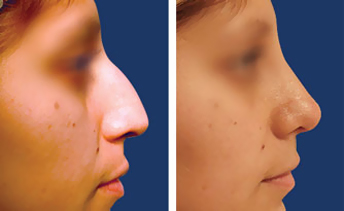


Feminizing rhinoplasty — nose feminization surgery at T-Change Buenos Aires
Actual Patient
Facial Feminization Surgery

Feminizing
Rhinoplasty
Surgery

One of the key procedures in FFS — refining the nose to achieve softer proportions, a more delicate tip and a naturally feminine profile in harmony with the whole face.

What is it

The nose is the centerpiece of the face — and one of the clearest facial gender markers

Pretty female noses tend to be smaller than male ones in every dimension. The bridge is typically narrower and straighter — or gently curved in. The tip is more sharply defined, and the angles where the nose meets the forehead and upper lip are more open in females than in males, where these angles tend to be more acute.

These proportional differences are what feminizing rhinoplasty addresses — not just making the nose smaller, but reshaping it so that it reads as unambiguously feminine and sits in natural harmony with the rest of the face.

When forehead contouring is performed in the same session, the top of the nasal bridge is reshaped from above through the forehead incision — ensuring a smooth, natural continuity between both facial areas. This is one of the key reasons to combine both procedures whenever possible.

Procedure at a glance

Surgery duration1–3 hours
AnaesthesiaGeneral (or local + sedation)
Hospital stayOutpatient or 1 night
Cast removal7-8 days post-op
Return to social activities~1 week
Return to exercise~1 month, but avoid contact sports for 6 months
Final results visible6–12 months
Surgical Technique

How is a male nose feminized?

The surgeon accesses the cartilages and bone through the nostrils — shaving and reshaping them to reduce width and length, straighten the bridge and define the tip.

01

Bridge & Profile

Narrowing & straightening
the nasal bridge

The bone and cartilage of the bridge are shaved and cut with an ultrasound saw (piezotome) to reshape and reduce width, correct any dorsal hump and create the straighter or subtly curved-in profile characteristic of feminine noses. When forehead surgery is performed simultaneously, the top of the bridge is refined from above through the forehead incision — achieving a seamless transition between both areas.

Often combined with forehead surgery
02

Tip & Nostrils

Tip definition &
alarplasty

The tip cartilages are reshaped to create a more defined, feminine point. When needed, the nostrils can also be narrowed through alarplasty — two small incisions at the base of the nostril wings that leave very discrete scars, which typically become undetectable within a few months. The tip is the area that takes the longest to reach its final shape.

Alarplasty scars usually become undetectable
i

About scars

In most cases all incisions remain inside the nose and are therefore invisible. The only exceptions are alarplasty, when it's needed to reduce nostril width, and very complex rhinoplasties that can't be approached through the nostrils and need a small incision across the columella — but the scarring on nasal skin is consistently very good and most of the times scars become unnoticeable within a short time after surgery.

Recovery

What to expect
after surgery

Recovery from feminizing rhinoplasty is manageable — though it requires patience, especially in the early days. Bruising under the eyes is normal and tends to intensify during the first two or three days before gradually fading. Most patients feel significantly better than they look.

One thing worth knowing: during the first weeks, some patients go through a period of doubt or emotional difficulty adjusting to their new appearance. This is a known and temporary phase. The vast majority of patients who are satisfied with their final result have gone through it.

  • Nose blocked with internal swelling for some days — breathing through the mouth is necessary
  • Cast applied for 7-8 days to protect shape and control swelling
  • Sleep with head elevated during the first days to support healing
  • Cold compresses are helpful during the first days to reduce bruising
  • Some sporadic bleeding may occur for up to 3 days — this is normal
  • Avoid heavy glasses sitting on the nose bridge since cast removal on day 7-8 until 1 month post op
  • Pain level is medium — most patients describe it as strong discomfort rather than acute pain
Ask Us Anything

Risks & complications

Asymmetry

Rhinoplasty has the highest revision rate of any facial procedure. Minor asymmetries can be corrected after 6 months.

Infection

Very unlikely when the appropriate antibiotic protocol is followed post-surgery.

Broken capillaries

Small red dots may appear on the skin surface — these are temporary and resolve on their own.

Impact during healing

The new nose is fragile during healing. Any accidental hit before full recovery can alter the final result.

Ready to take the next step?
We're here to guide you.

Book a free online consultation with our team. We'll review your goals, answer your questions and outline a personalized surgical plan — before you commit to anything.

Real Results

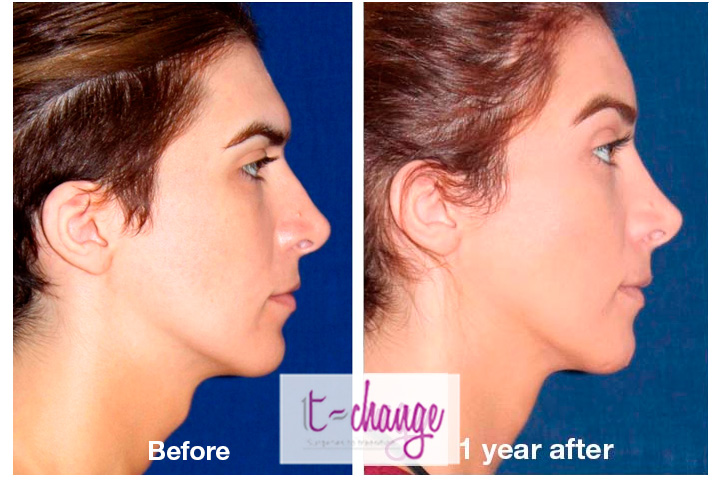
Feminizing rhinoplasty — before & after

All photos published with patient consent. Individual results vary based on anatomy, procedures performed and recovery.
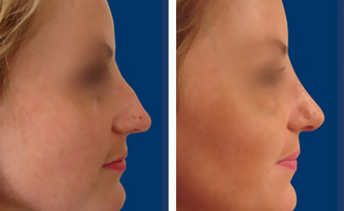
Before & After Feminizing rhinoplasty before and after — nose feminization at T-Change Buenos Aires

Feminizing Rhinoplasty

Actual Patient
Before & After Feminizing rhinoplasty before and after — bridge and tip refinement at T-Change Buenos Aires

Nose Reduction

Actual Patient
Before & After Feminizing rhinoplasty before and after — alarplasty and profile at T-Change Buenos Aires

Nose Feminization

Actual Patient

Start with a free consultation.
No commitment required.

Send us your photos and we'll prepare a personalized surgical proposal — outlining which procedures suit your anatomy and your goals, with a full quote, before you travel.

Contact Us